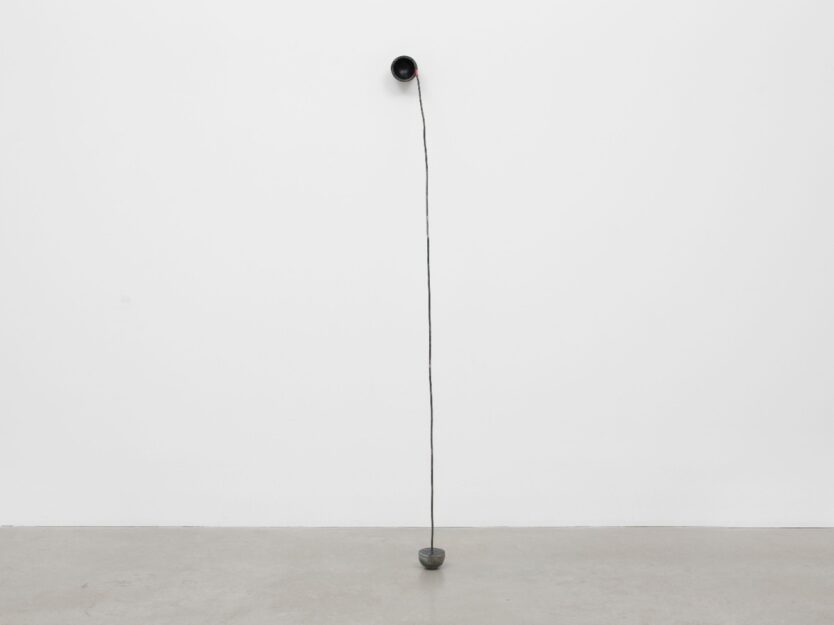
The Derek Williams Trust is thrilled to have recently acquired April (1982) by Alison Wilding for its collection.
Wilding rose to prominence in the 1980s as part of the New British Sculpture group. Characterised by a playfulness and an eclectic approach to materials, the group emerged in response to the minimalist and conceptual styles which dominated sculptural practice in the UK during the 1960s and 70s. Wilding’s subtle, contemplative works reject traditional hierarchies of material, often combining the industrial and organic and created using whatever is to hand at the time.
In April, a grounded lead ladle form is pierced by a patinated aluminium rod which curves skywards to meet a carved limewood bowl. The tip of the rod is concealed by a tiny red silk sleeve which just ‘kisses’ the edge of the bowl, a conduit which activates the mirroring forms of the lead and limewood and the space around and between them.
As in much of Wilding’s work, interactions between the elements are not fixed but reveal themselves via the delicate balance of their respective physical properties. Wilding’s facility with materials and her pleasure in transformation and juxtaposition is clear in April: the rough moulding of the lead with its waxy coating is almost lithic, while the highly-finished surface of the limewood receptacle is polished to a metallic-looking sheen.
April joins sculptural works in the Derek Williams Trust’s collection including pieces by Henry Moore and Anthony Caro; and, more broadly, sits alongside examples of New British Sculpture in the collections at Amgueddfa Cymru as well as the museum’s growing body of contemporary sculpture by women artists including Laura Ford, Alice Channer and Angharad Pearce Jones.
See Alison Wilding talking about April here.